If you are considering Invisalign treatment, you may have noticed small, tooth-coloured bumps placed on certain teeth. These are called Invisalign attachments. Many patients ask me whether these small attachments are really necessary and how they help straighten teeth.
As an orthodontist, I, Dr. Ruchi Saxena, would like to explain why Invisalign attachments play an important role in achieving a beautiful, healthy and well-aligned smile.
1. What Are Invisalign Attachments?
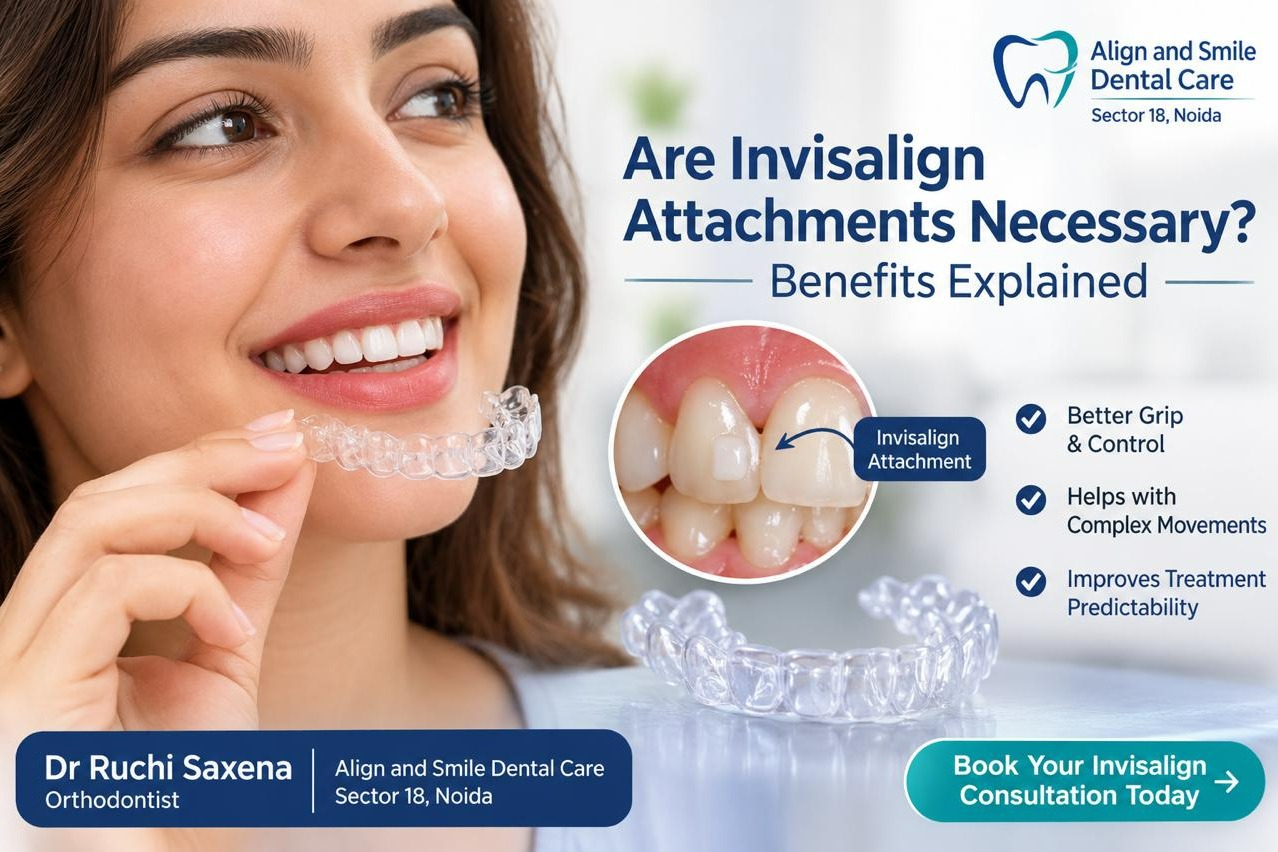
Invisalign attachments are small, tooth-coloured shapes made from dental composite material that are temporarily bonded to selected teeth during Invisalign treatment.
They act as tiny handles that help Invisalign aligners grip the teeth and apply the right amount of pressure in specific directions.
Unlike the aligners, which are removable, attachments remain on your teeth throughout the stages of treatment when they are required.
2. Why Are Attachments Important in Invisalign Treatment?
Attachments are important because not all tooth movements can be achieved effectively with aligners alone.
As an orthodontist, I use attachments to improve the grip of Invisalign aligners and help achieve more controlled tooth movements.
They help with:
Rotating teeth: Some teeth, particularly canines and premolars, can be difficult to rotate without additional support.
Moving teeth vertically: Attachments help with movements such as pushing teeth into the gum line or bringing them out.
Controlling tooth angulation: They help achieve better control over the direction and position of individual teeth.
Closing gaps: Attachments can assist in controlling tooth movement while closing spaces between teeth.
Bodily tooth movement: They help the aligners achieve more controlled movement of the entire tooth rather than simply tipping its crown.
The type, shape and position of attachments depend on your individual orthodontic requirements.
3. How Do Invisalign Attachments Work?
Invisalign attachments work by providing additional contact points between your teeth and the clear aligners.
The aligners are designed with specific spaces that fit over these attachments. When you wear your aligners, the attachments help transfer the planned orthodontic forces to the teeth.
Think of them as small grips that help the aligners guide your teeth into their desired positions.
This additional grip allows me to plan and achieve more predictable tooth movements in cases where attachments are needed.
4. Are Invisalign Attachments Visible?
One of the biggest advantages of Invisalign attachments is that they are made using tooth-coloured composite material.
They are designed to blend with your natural teeth and are generally less noticeable than traditional metal braces.
However, their visibility depends on:
The number of attachments required.
Their size and shape.
Their position on your teeth.
Your natural tooth shade.
Although they may be slightly noticeable at close range, most patients find them aesthetically acceptable.
5. Does Every Invisalign Patient Need Attachments?
No, every Invisalign patient does not necessarily need attachments.
The requirement depends on the complexity of your orthodontic problem and the type of tooth movements needed.
Some patients with minor alignment concerns may require very few attachments or none at all, while patients with more complex orthodontic problems may need multiple attachments.
During your consultation, I evaluate your teeth, bite and smile to determine whether attachments are necessary for your treatment.
6. Do Invisalign Attachments Hurt?
Getting Invisalign attachments bonded to your teeth is generally a painless procedure.
I use a dental bonding technique to place the attachments on selected teeth. You may experience mild pressure or some temporary discomfort when wearing your new aligners, especially during the initial days of a new aligner set.
This is usually related to the orthodontic forces moving your teeth rather than the attachments themselves.
Most patients adapt to the attachments and aligners within a few days.
7. Can I Eat Normally With Invisalign Attachments?
Yes, you can continue enjoying your regular meals, but you must remove your Invisalign aligners before eating.
The attachments remain bonded to your teeth, so it is important to avoid biting excessively hard or sticky foods that could damage or dislodge them.
I also recommend brushing your teeth after meals before putting your aligners back in.
Maintaining good oral hygiene is essential throughout Invisalign treatment.
8. What Happens If an Invisalign Attachment Falls Off?
Sometimes an attachment may become loose or fall off during treatment.
Although this is not usually an emergency, you should inform your orthodontist as soon as possible.
An attachment helps the aligner perform its planned movement. If it falls off, the aligner may not grip that particular tooth as intended.
I will assess whether the attachment needs to be replaced to keep your treatment progressing according to plan.
Please do not try to fix or bond an attachment yourself.
9. How Long Do Invisalign Attachments Stay on Your Teeth?
Invisalign attachments generally remain on your teeth for as long as they are required to achieve the planned tooth movements.
Some attachments may be removed or changed during treatment, depending on your progress and the next stage of your treatment plan.
Once your Invisalign treatment is complete, I carefully remove the attachments and polish the tooth surfaces to remove any remaining bonding material.
10. Do Invisalign Attachments Make Treatment Faster?
Attachments do not automatically make Invisalign treatment faster.
Their main purpose is to improve the control and effectiveness of specific tooth movements.
When attachments are appropriately planned and used, they can help achieve the intended movements more efficiently and reduce the possibility of certain teeth falling behind the planned position.
However, treatment duration depends on several factors, including the complexity of your case, biological response, aligner wear and compliance with instructions.
For the best results, I recommend wearing your Invisalign aligners for the prescribed 20–22 hours per day, unless I advise otherwise.
11. Can Invisalign Work Without Attachments?
Yes, Invisalign can work without attachments in selected cases.
However, some orthodontic movements are difficult to achieve with aligners alone.
Without the necessary attachments, certain teeth may not move as accurately as planned, potentially requiring treatment modifications or additional aligners.
As an orthodontist, my priority is not simply to make your teeth look straight but to achieve a healthy, functional and well-balanced bite.
That is why I recommend attachments whenever they are clinically necessary.
12. Are Invisalign Attachments Better Than Traditional Braces?
Invisalign attachments and traditional braces work differently.
Traditional braces use brackets and wires to apply orthodontic forces, whereas Invisalign uses a series of removable clear aligners, sometimes supported by attachments.
The choice depends on your dental condition, bite problem, treatment goals and personal preferences.
Invisalign offers the advantage of being removable and aesthetically discreet. However, not every orthodontic case is suitable for Invisalign alone.
A proper orthodontic evaluation is important before deciding which treatment is best for you.
13. How Can I Take Care of My Invisalign Attachments?
Taking care of Invisalign attachments is simple. I recommend following these steps:
Brush your teeth twice daily using a soft-bristled toothbrush.
Clean around the attachments carefully to prevent plaque accumulation.
Floss daily to maintain healthy gums.
Remove aligners before eating or drinking anything other than water.
Clean your aligners regularly.
Wear your aligners for the prescribed number of hours.
Visit your orthodontist for scheduled follow-up appointments.
Good oral hygiene and consistent aligner wear are essential for successful treatment.
Final Thoughts: Why I Consider Invisalign Attachments Important
Invisalign attachments may look like tiny additions to your teeth, but they can make a significant difference in controlling tooth movement.
As an orthodontist, I believe successful Invisalign treatment is about much more than simply wearing transparent aligners. It requires accurate diagnosis, careful treatment planning, appropriate attachment placement and regular monitoring.
Every smile is different, and your Invisalign treatment should be planned according to your individual dental needs.
Ready to Transform Your Smile With Invisalign?
If you are thinking about straightening your teeth without traditional metal braces, I would be happy to guide you.
I am Dr. Ruchi Saxena, Orthodontist, and I invite you to book an orthodontic consultation to understand whether Invisalign treatment is suitable for your smile.
Let's discuss your smile goals and create a personalised treatment plan to help you achieve a confident, healthy and beautifully aligned smile.
Book your Invisalign consultation with Dr. Ruchi Saxena at Align and Smile Dental care , Sector 18 Noida today!
Your journey towards a confident smile starts with the right orthodontic advice.
Keywords